CONCRETE PAVING
Plan concrete around your property's daily demands.

PLAN FOR DAILY DEMAND
Build the paving plan around how your property operates.
Loads, soil support, drainage, joints and curing all influence concrete performance. Connect those details with access needs and the way your property is used.
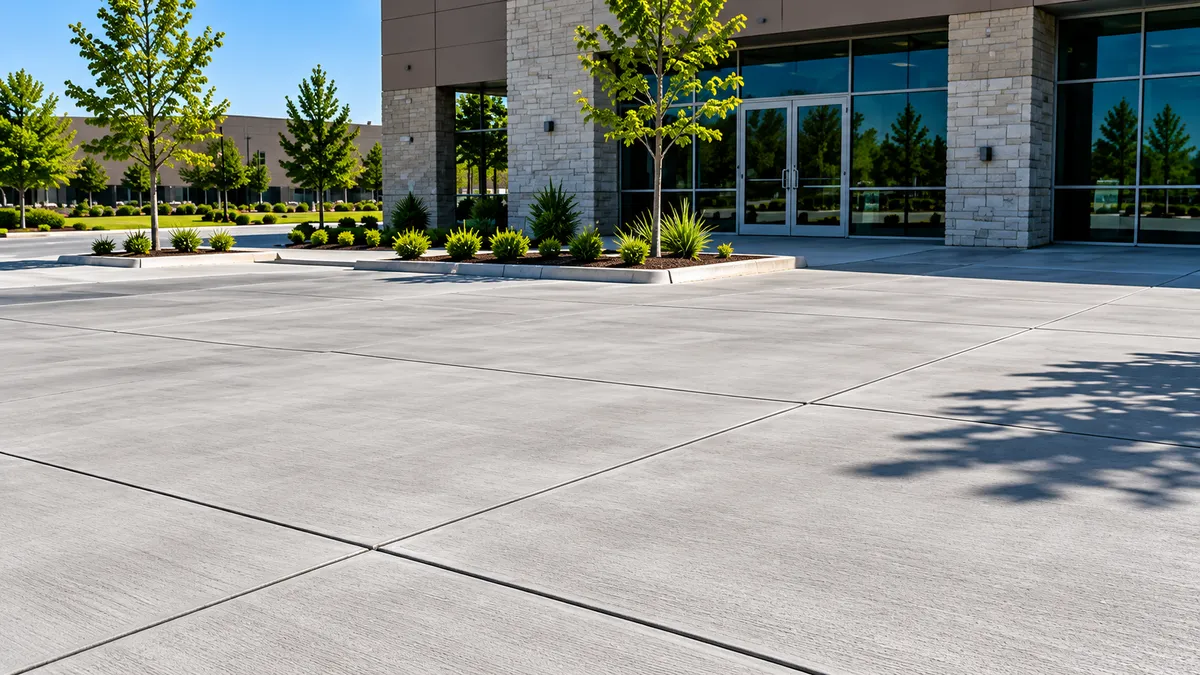
Illustrative concrete paving.

Design for the traffic
Passenger parking and truck routes place different demands on concrete.

Plan the joints
Joint layout helps manage crack locations and movement.

Protect early strength
Curing supports strength and surface durability.
Is concrete paving the right next step?
Good fit
Defined vehicle use, site conditions and a project-specific design.
Evaluate first
Unknown loads, variable soils, ponding or limited closure space.
Serving properties in Tulsa, Oklahoma City and Northwest Arkansas.
FAQ
Before you pave.
How thick should the pavement be?
Thickness depends on traffic, support and concrete strength.
Do joints prevent every crack?
No. Joint layout helps control crack locations and movement.
When can vehicles return?
Opening depends on required strength, curing and loading.
GET A QUOTE
Tell us about your project and its location so we can understand what you need.
WHAT THE PAVING PLAN SHOULD COVER
A clear path from here.
01
Map how the site works
Review vehicles, entrances and drainage.
02
Set the pavement details
Coordinate support, thickness and joints.
03
Allow for curing
Establish requirements for reopening.
Let’s talk about your property.
Asphalt. Concrete. Ongoing care.
Practical solutions for your property.
LOCATIONS SERVED
Tulsa
Oklahoma City
Northwest Arkansas
Southwest Missouri
Southeast Kansas
Tulsa
Oklahoma City
Northwest Arkansas
Southwest Missouri
Southeast Kansas
© 2026 Regional Groundwork. All rights reserved.